The Short Version
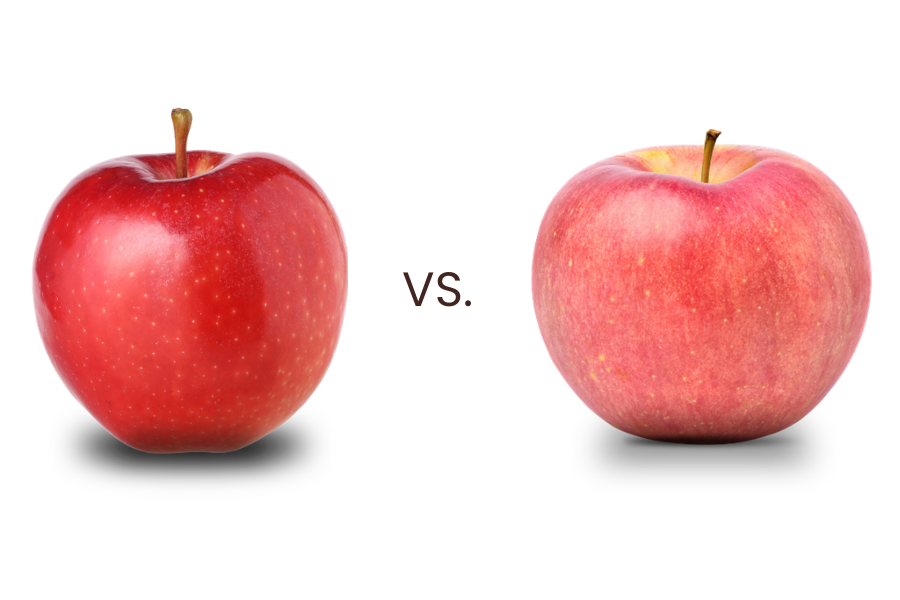
Gala and Fuji are both sweet, low-acid eating apples, and they are the two most planted varieties in the country. Fuji is noticeably sweeter and denser, stores longer, and arrives about a month later. Gala is milder, softer, thinner-skinned and the friendlier choice for small children.
Want the sweeter apple? Buy Fuji. Want the gentler one? Buy Gala.
Fuji is the sweeter apple
Fuji is sweeter. On our sweetness scale Fuji sits at a 10 and Gala at a 7, and that gap is bigger in the mouth than it looks on paper, because Fuji also has denser flesh that holds more juice.
Everything else follows from that. Fuji eats like a dessert apple. Gala eats like an everyday apple.
Side by Side
Gala vs Fuji at a glance.
| Attribute | Gala | Fuji |
|---|---|---|
| Sweetness | 7 of 10 | 10 of 10 |
| Texture | Crisp, fine grained, softer | Very crisp, dense, heavy |
| Skin | Thin, easy for kids | Thicker, a little chewy |
| Flavor | Mild, floral, gentle | Rich, honeyed, almost candy-like |
| Michigan harvest | Late August | Late September |
| Storage | Good | Excellent, one of the best |
| Best for | Snacking, lunchboxes, salads | Snacking, lunchboxes, cheese boards |
| Origin | New Zealand, 1930s | Japan, 1930s |
How Gala and Fuji taste
Gala is the gentler of the two. Sweet without being sugary, with a faint floral note some people describe as pear-like. Low acid, so it never reads as tart. The flesh is fine grained and softens quickly once the apple warms up, which is part of why it works so well for young children.
Fuji is sweet in a way that surprises people who have not had a good one. Dense, extremely juicy, with a honey character and almost no acid to cut it. The flesh is heavier and coarser than Gala, and it stays crunchy far longer after slicing.
Tasted blind side by side, the sweetness gap is obvious in the first bite.
Which one holds up better
This is where the practical difference lives.
Fuji stores exceptionally well. It is one of the best keeping apples grown anywhere. A Fuji bought in March out of controlled atmosphere storage still eats crisp, which is why it is on shelves year round in a way most varieties are not.
Gala is good but not exceptional. It holds fine for months in proper cold storage, but it softens faster than Fuji once it is in your fruit bowl. Gala is at its best in early fall, close to harvest.
Cut fruit tells the same story. Fuji resists browning noticeably longer, which matters for lunchboxes and cheese boards.
When each one arrives
In Michigan, Gala harvest starts around August 24 and Fuji around September 21. Roughly a month apart.
That gap is useful. Gala opens the season and signals fall is coming. Fuji harvests late, then carries through winter and into spring out of storage.
If you are buying Michigan apples in September, both are available fresh. If you are buying in April, you are almost certainly holding a Fuji.
The Verdict
Which one should you buy?
Buy Gala if
You are packing lunches for small children, you want thin skin, you prefer a milder apple, or you are buying in early fall and want something just picked.
Buy Fuji if
You want the sweeter apple, you want it to stay crunchy in a lunchbox all morning, you are slicing ahead for a platter, or you are buying in late winter and want something that still eats like autumn.
One Caveat
For cooking, pick neither.
Both are low acid and very sweet, which means they go flat and can turn soft under heat. A pie wants Jonathan, Rome, Cortland or Ida Red. If Gala or Fuji is all you have, Fuji holds its shape better of the two, but neither is the right tool.
Where they came from
They are related, in a roundabout way.
Gala was bred in New Zealand in the 1930s from Kidd’s Orange Red and Golden Delicious. Fuji was bred in Fujisaki, Japan, also starting in the 1930s, from Red Delicious and Ralls Janet. Ralls Janet traces back to American stock, and Golden Delicious shows up in the parentage of a remarkable number of modern apples.
Both arrived in the United States decades after they were bred, Gala in the 1970s and Fuji in the 1980s, and both went from unknown to everywhere. More on this in our glossary and origins guide.
Questions
Gala and Fuji, answered.
Which is sweeter, Gala or Fuji?
Fuji. On our 1 to 10 scale Fuji is a 10 and Gala is a 7. Fuji also has denser flesh and more juice, so the sweetness reads even stronger than the numbers suggest.
Which is crunchier, Gala or Fuji?
Fuji. It has denser, heavier flesh that stays crisp longer, both in storage and after slicing. Gala is crisp when fresh but softens faster.
Are Gala and Fuji good for baking?
Not particularly. Both are low acid and very sweet, so they lose flavor definition under heat and can go soft. Use Jonathan, Rome, Cortland or Ida Red for pie. Fuji is the better of the two if you have no choice.
Which apple is better for kids?
Gala, usually. Thinner skin, smaller average size, milder flavor and softer flesh. Fuji works too and holds up better in a lunchbox, but the skin is tougher for small children.
Which stores longer, Gala or Fuji?
Fuji, by a clear margin. It is among the best keeping apples grown and stays crisp in controlled atmosphere storage well into spring.
When are Gala and Fuji apples in season in Michigan?
Gala harvest starts around August 24 and Fuji around September 21. Both are available from storage through the winter, with Fuji holding quality longer.
Is the Fuji apple from Japan?
Yes. It was developed in Fujisaki, Japan starting in the 1930s from a cross of Red Delicious and Ralls Janet. Named for the town, not the mountain.