The short version
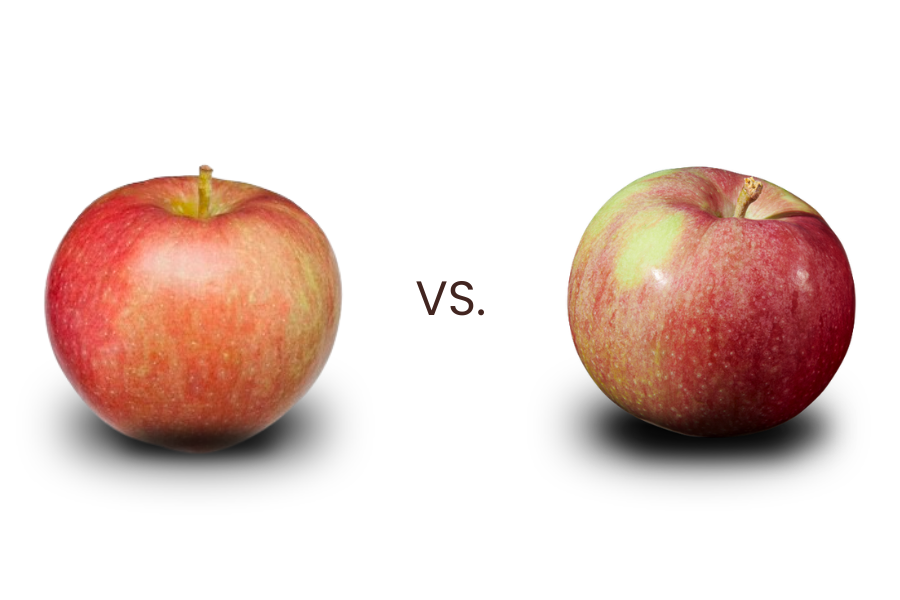
Paula Red arrives in mid August, more than two weeks before McIntosh, and disappears fast. Both are tart, squat and red over yellow. Paula Red is softer and better for sauce. McIntosh is more aromatic, stores far longer and makes better cider.
Easy to confuse, weeks apart
These two are easy to confuse in a bin. Similar shape, similar coloring, similar tartness. Paula Red sits at a 2 of 10 on our sweetness scale and McIntosh at a 3.
The difference that matters is timing. Paula Red is the first summer apple of the year in Michigan. If you see one on a shelf in August, the fall crop has not started yet.
Paula Red and McIntosh at a glance
| Attribute | Paula Red | McIntosh |
|---|---|---|
| Sweetness | 2 of 10 | 3 of 10 |
| Flavor | Bright and tart, hints of strawberry | Tangy, tart, strongly aromatic |
| Texture | Softer flesh, cooks down quickly | Tender, ultra juicy white flesh |
| Appearance | Squat, vivid red over yellow | Squat, pink-red over green |
| Michigan harvest | Around August 19 | Around September 5 |
| Availability | Very short, late summer only | September through June |
| Best for | Applesauce, apple butter, crisps | Cider, sauce, baking blends |
| Origin | Fruit Ridge, Michigan, 1960 | Ontario, early 1800s |
How they taste
Paula Red is bright and pleasingly tart, and people regularly pick up notes of strawberry or pear behind the acidity. It tastes like an apple that has not fully committed to fall yet, which is exactly what it is.
McIntosh is tangier with a much stronger aroma, the smell most people associate with apples generally. The flesh is tender and extremely juicy. Michigan’s cool nights sharpen the flavor rather than dulling it.
Paula Red was found on the Ridge
This one is ours. Paula Red was discovered in 1960 on the Fruit Ridge, the growing region northwest of Grand Rapids where Riveridge is based. The grower named it after his wife, Pauline. It reached the market about eight years later.
McIntosh came out of Ontario in the early 1800s, entered commercial production in the 1870s and spread through the Northeast and west into Michigan, where the climate suits it well.
Which one to cook with
For applesauce and apple butter, Paula Red. Its flesh softens quickly under heat, which gives you a smooth, flavorful sauce without much work. Apple butter in particular is a good use, since it is a simpler and more fruit-forward alternative to jam.
For cider, McIntosh. The balance of sugar and acid plus the sheer volume of juice makes it the standard base.
Neither is a first-choice pie apple on its own. Both break down under heat, which is a problem when you want slices to stay slices.
The window is the whole point
Paula Red harvests around August 19 and is often gone from shelves before many fall varieties are even picked. There is no storage program to fall back on. If you want it, buy it in late August.
McIntosh harvests around September 5 and ships through June, one of the longest seasons of any Michigan variety.
Reach for Paula Red if
It is August, you want the first Michigan apple of the year, or you are making applesauce or apple butter and want fruit that cooks down fast.
Reach for McIntosh if
You are making cider, you want that classic tart apple aroma, or you need a tart apple any time between September and June.
Buy them when you see them
Paula Red has no winter season. It is picked, packed, sold and finished inside a few weeks. That is not a supply problem, it is simply what an early summer apple is.
Paula Red and McIntosh, answered
What variety is best for making applesauce?
Paula Red. Its flesh softens quickly when cooked, which makes smooth, flavorful sauce. It is also excellent for apple butter.
Why can I only find Paula Red in August?
It is one of the first varieties harvested each year and it does not hold in storage the way fall apples do. The season is short by nature.
Where did Paula Red come from?
It was discovered in 1960 on the Fruit Ridge northwest of Grand Rapids, the same growing region Riveridge calls home, and named after the grower’s wife Pauline.
Are Paula Red and McIntosh related?
Paula Red was a chance seedling, so its exact parentage is not documented. The resemblance in shape, color and tartness is real, but it is not a confirmed McIntosh cross.
Can I substitute one for the other?
In sauce, yes, and easily. In cider, use McIntosh. Paula Red is generally gone by the time cider season is running.